This was written in late 2015 or early 2016, and I would write differently today. Nevertheless, I add an entirely unedited copy here. Just for fun.
In his book River Out of Eden Richard Dawkins offers an insight into how it is necessary to go into extreme simplification to argue for his brand of evolution.
Creationism has enduring appeal, and the reason is not far to seek. It is not, at least for most of the people I encounter, because of a commitment to the literal truth of Genesis or some other tribal origin story. Rather it is that people discover for themselves the beauty and complexity of the living world and conclude that it “obviously” must have been designed.
Dawkins received a letter “from an American minister who had been an atheist but was converted by reading an article in National Geographic – Love and Lies – which is a both interesting and entertaining article so I recommend reading it in full. The minister involuntary sets up a honey trap in his letter, and Dawkins happily jumps into it.
??????
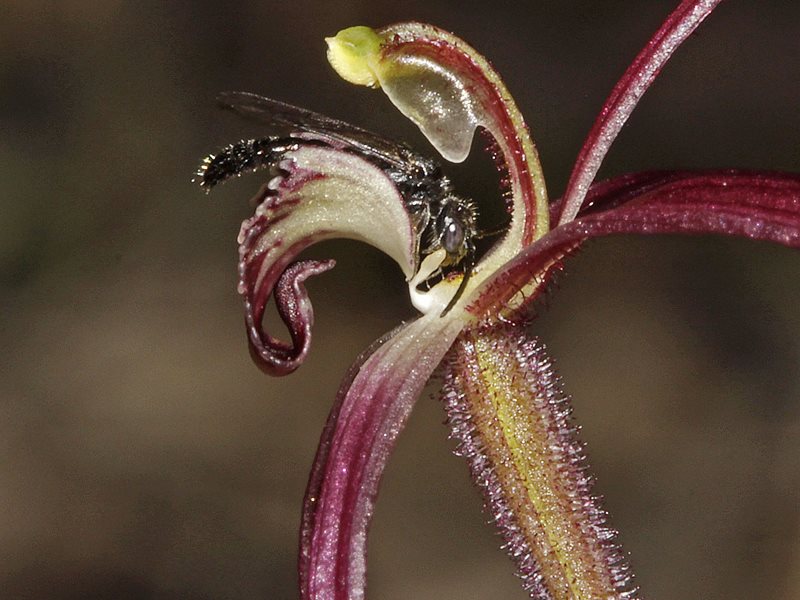
The article was about the amazing adaptations that orchids have made to their environments in order to propagate successfully. As I read I was particularly intrigued by the reproductive strategy of one species, which involved the cooperation of a male wasp. Apparently the flower resembled very closely the female of this species of wasp, including having an opening in the proper place, so that the male wasp might just reach, by copulating with the flower, the pollen produced by the blossom. […] And what made the flower attractive to the wasp in the first place was that it emitted pheromones [specific chemical attractants much used by insects to bring the sexes together] identical to the female of that species of wasp. […] Then, with a terrific sense of shock, I realized that in order for that reproductive strategy to have worked at all, it had to be perfect the first time.
Delirious from all that honey Dawkins happily jumps into his usual superiority mode:
What always impresses me whenever I hear this kind of argument is the confidence with which it is asserted. How, I want to ask the minister, can you be so sure that the wasp-mimicking orchid (or the eye, or whatever) wouldn’t work unless every part of it was perfect and in place? Have you, in fact, given the matter a split-second’s thought? Do you actually know the first thing about orchids, or wasps, or the eyes with which wasps look at females and orchids? What emboldens you to assert that wasps are so hard to fool that the orchid’s resemblance would have to be perfect in all dimensions in order to work?
In the rest of the chapter Dawkins goes to great length to demonstrate that “gradual evolution of so-and-so couldn’t have happened, because so and-so ‘obviously’ has to be perfect and complete if it is to work at all.”
I may have done my work too well in persuading you that wasps are likely to be easy to fool. You may be nurturing a suspicion almost opposite to that of my ordained correspondent. If insect eyesight is so poor, and if wasps are so easy to fool, why does the orchid bother to make its flower as wasplike as it is?
Apart from typical Freudian slips like forgetting that the orchid doesn’t bother at all to make something – forgotten chance and natural selection? – all his arguments are about how evolution produced Orchids Being Wasplike. “Half a wasp is better than no wasp.”
So …. Once upon a time there was a little Orchid sporting an evolutionary experiment looking like a quarter of a Wasp. “Wow!”, Mr Wasp thought. “Here is a lady for me!” Landing on the Orchid, he is immediately disappointed since he can’t find a hole where he can put his you-know-what to have some fun. As it happened, the Orchid was equally frustrated since it had forgotten to add some pollen into the quarter of a wasp. This was a total failure, since the orchid desperately needed some intercourse here to at all be able to become more wasplike.
Leaving the fairy tales behind us we will notice that Dawkins reduce an extremely complex interaction between three players: the orchid, the male wasp, and the female wasp. We thus have to take three evolutionary processes into account, and I can understand why Dawkins avoided these complications. I also think these processes have to include the development of The Sexy Scent aka pheromones. Here is a sample menu to choose from.

My comment 2022: I know nothing about chemistry, but what we must take for granted is that natural selection should make it possible
Since parallel evolution is already taken – as a synonym for divergent evolution – we can consider all this to be a simultaneous evolution. So focusing on the evolution of the production and reception of pheromones, we have to realize that this has to take place in all three players at the same time.
It should also be noted that there is absolutely no way for the female wasp and the orchid to ‘co-ordinate’ this evolutionary process. The orchid tries this pheromone and Lady Wasp tries that one. No luck. Let’s try again, so Mr Wasp will love us both. How can they accomplish this neat feat in some sort of gradual evolution? Did the orchid develop 50% of a complex pheromone molecule and the female wasp the other 50% and then prayed to the god of evolution that the parts in some mysterious way would combine to right one?
No, that doesn’t sound very probable, does it? Can Wikipedia come to the rescue? Here is what we can learn about the evolution of pheromones:
Evolution
Processing chemosignals like pheromones has evolved in all animal phyla and thus is the oldest phylogenetic receptive system shared by all organisms including bacteria. It has been suggested that it serves survival by generating appropriate behavioral responses to the signals of threat, sex and dominance status among members of the same species.
Furthermore, it has been suggested that in the evolution of unicellular prokaryotes to multicellular eukaryotes, primordial pheromone signaling between individuals may have evolved to paracrine and endocrine signaling within individual organisms.
Some authors assume that approach-avoidance reactions in animals, elicited by chemical cues, form the phylogenetic basis for the experience of emotions in humans.
I have emphasised “suggested, suggested and assume” above. Does this make us confident that science will be able to offer some real answers soon?
I am blissfully unknowing when it comes to ‘the evolution’ of different molecules. What sort of traditional evolution – random mutations and natural selection – can a molecule go through? Or is something entirely different taking place when a new type of molecule is popping out into the chain of evolution? Maybe there isn’t any gradual evolution here, or? Perhaps the entire menu above and more types of pheromones become available in one Mini Bang?
As suggested above prokaryotes and eukaryotes, two of the very first living beings on our planet, also had the pleasure of exporting and importing Sexy Scents, “generating appropriate behavioral responses to the signals of threat, sex and dominance”, we know that the production line is rather long measured in time.
In Soup, Cosmic Sperm, or Hot Spa? I formulated some sceptical questions arising from “suggestions”, “models”, “appears to be”, and “hypotheses” regarding the first steps in the evolution of life on Earth, so we “know” that it takes a lot of work to get the first building blocks in place. I think it is fair to assume that these heavy duty chemical processes are long gone when the little creatures acquired some pheromones.
Olfaction, the sense of smell, is like all senses exceedingly complex. We don’t have anything explaining the chain from physical reaction to the actual experience, i.e. when we smell and feel something.

Human olfactory system. 1: Olfactory bulb 2: Mitral cells 3: Bone 4: Nasal epithelium 5: Glomerulus 6: Olfactory receptor neurons
To be continued …..